Year-round E-15 is kingpin ag issue
Naig, White talk ag at Clay County Fair
-
-Farm News photo by Karen Schwaller
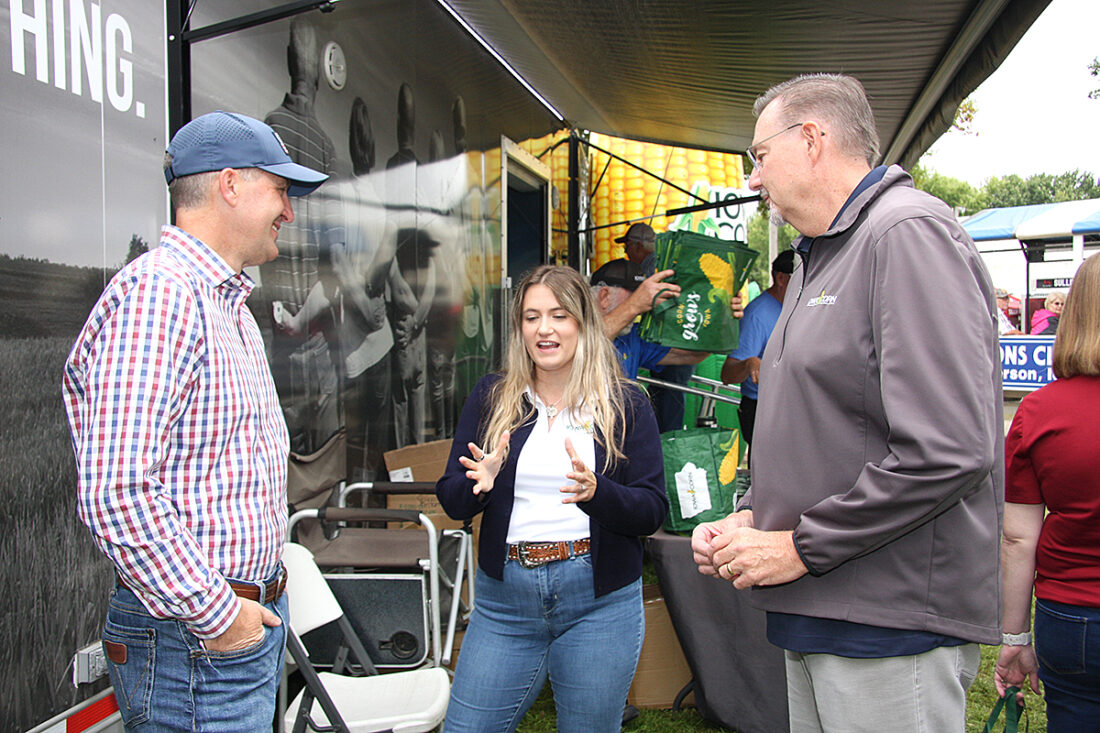
Iowa Secretary of Agriculture Mike Naig, left, visits with Gina White, District 1 Director for the Iowa Corn Promotion Board, and Craig Floss, CEO of the Iowa Corn Growers Association, at the Clay County Fair recently.
-
-Farm News photo by Karen Schwaller
Iowa Secretary of Agriculture Mike Naig waves to the crowd Sept. 17 while visiting the Clay County Fair on Iowa Corn Day.
-Farm News photo by Karen Schwaller
Iowa Secretary of Agriculture Mike Naig, left, visits with Gina White, District 1 Director for the Iowa Corn Promotion Board, and Craig Floss, CEO of the Iowa Corn Growers Association, at the Clay County Fair recently.
SPENCER — “Iowa Corn Day” at the Clay County Fair in Spencer Sept. 17 was highlighted by visits from Iowa Secretary of Agriculture Mike Naig, and Gina White, District 1 Director for the Iowa Corn Promotion Board.
Naig, who hails from Cylinder, was elected Ag Secretary in 2018, and is currently running for his third term on the platform of “Strong Agriculture.”
“Strong ag is not just good for farmers and the farming community, but it’s good for all Iowans,” he said. “We’re trying to drive home the point that we’re all better off when we have strong ag.”
Naig said there are plenty of challenges on the plate for Iowa farmers, but he still thinks opportunity awaits.
“I’m optimistic but not naive,” he said. “We need to continue to improve water quality in the state, but we have set records for conservation adoption the last five years in a row, so let’s build on our strengths.”

-Farm News photo by Karen Schwaller
Iowa Secretary of Agriculture Mike Naig waves to the crowd Sept. 17 while visiting the Clay County Fair on Iowa Corn Day.
Naig said one positive is that the latest Farm Bill passed through the Senate Ag Committee on Sept. 16, on its way to advancement. He also said the search for markets is ongoing and strong.
“Internationally there have been some stronger signals on corn and ethanol exports, and we need to continue to promote that and push for a diversified trade portfolio,” he said, adding that China is buying soybeans again also.
Domestically, he said year-round access to E-15 (included in the Senate version of the Farm Bill) is a significant growth signal for ethanol. Market expansion is also happening locally as producers work more and more with customers right next door.
“We’re seeing an interest in expansion in local foods through our ‘Choose Iowa’ program — a signature brand program for Iowa-grown, Iowa-made and Iowa-raised. So we’re fighting for markets wherever we can.”
Globally, he said the ag world has experienced a disrupted marketplace, and supply chains that reach across the globe with the disruption in the Middle East, which hurt trade opportunities. He added that foreign animal diseases such as African swine fever and foot and mouth disease play a part in the disruption in the ag supply chain.
“But we try to anticipate those things and be ready to respond, and we have to manage around the risks that we cannot control,” said Naig. “That’s agriculture.”
Naig said the corn crop across Iowa appears to be dryer as he travels north and west, and wetter in areas south and east. He expects both extremes to result in lower yields.
“Even with that, I expect the crop will be solid — it will just be variable,” he said, adding that profitability is still a front-burner concern.
“Prices are still not where we want them to be, and input prices continue to be high, and now we have higher fuel and fertilizer costs that are continuing to add pressure, along with policy uncertainty,” he said.
Iowa corn
Gina White, District 1 Director for the Iowa Corn Promotion Board, farms today near Spencer with her husband, Patrick, and father-in-law, Chuck White.
She said the big topics for the Iowa corn industry are year-round E-15, getting the Farm Bill passed and helping increase the price of corn through exports.
“China is thinking about sending a delegation to the U.S. in the next month or so, and it would be good to meet with China and make sure they are buying our ag products,” she said, adding that U.S.M.C.A. (U.S.-Mexico-Canada Agreement) is also something they’ve been working on.
“Mexico wants to come to the table and talk to our legislators about trade; Canada has been a little more hesitant to come to that table — there are some things they want for their own farmers, too, which is understandable because they should be fighting for their farmers, too,” said White.
She said China has been buying much of their corn from Brazil and other places in South America, and that the U.S. is trying to get a seat at that table. She said Mexico and South Korea are big trade partners for corn, and Canada has typically come through with good demand for U.S. ethanol.
White said trade tariffs are a discouragement to U.S. farmers, but said corn prices were up during the third week of September, and she expects that trajectory to continue with the El Nino weather pattern progressing across the country and across the world.
“Brazil and Argentina in South America, and Europe have been struggling with their crops, so there’s an opportunity for U.S. farmers to step into those markets and make up the differences, at least to start with,” she said.
While countries like South America experience weather that lets them plant more than one crop in a year, White said the quality of U.S. corn is a strong selling point.
“Our farmers take really good care of their crop and they’re backed by good genetics, so those are the stand-out points,” she said.
White said the controversy about GMO vs. non-GMO grain continues.
“GMO is just genetic editing,” she explained. “Any crop that’s in your garden is a GMO — it’s when they cross pollinate. I always tell people the GMO factor is so miniscule by the time that corn actually gets to your plate.”
She illustrated that comment by saying corn has to grow and mature, be fed to livestock (if that’s the path for that grain) and finally get into the food chain to feed humans.
She said the disconnect from consumers to the farm is profound, and the main way consumers can sort out fact from fiction is by farmers telling their stories.
“Some (consumers) have probably never stepped foot on a farm or learned anything about how conservation-minded farmers are,” she said.
White spoke of the importance of making sure consumers understand how important it is that year-round E-15 be approved and used.
“In Chicago where I’m from, it’s labeled as ‘Unleaded-88,’ and when they come out here they see ‘E-15’ and don’t realize it’s the same product,” she said, adding that the difference in labeling might be from varying regulations from state to state on how they can market the fuel. “We want to get E-15 further into California, too.”
White said Iowa has some of the “best corn growers” because they are becoming more and more active in newer conservation practices.
“On our farm, we do a lot of no-till cover crops,” she said. “Usually all of our soybeans are planted no-till into a standing rye cover crop; our corn is usually strip-tilled, so there’s minimal soil disturbance. Our farmers are conservation-minded, and we want to make sure the soil is good for the next generation and the next one after that.”
Local News
How beneficial is the diesel penalty suspension?
Just before combines really got rolling for harvest, Gov. Kim Reynolds signed a proclamation in line with an ...
Learning by doing