Trained to protect, serve
K-9 peace officers demonstrate skills at Clay Co. Fair
-
-Farm News photo by Karen Schwaller
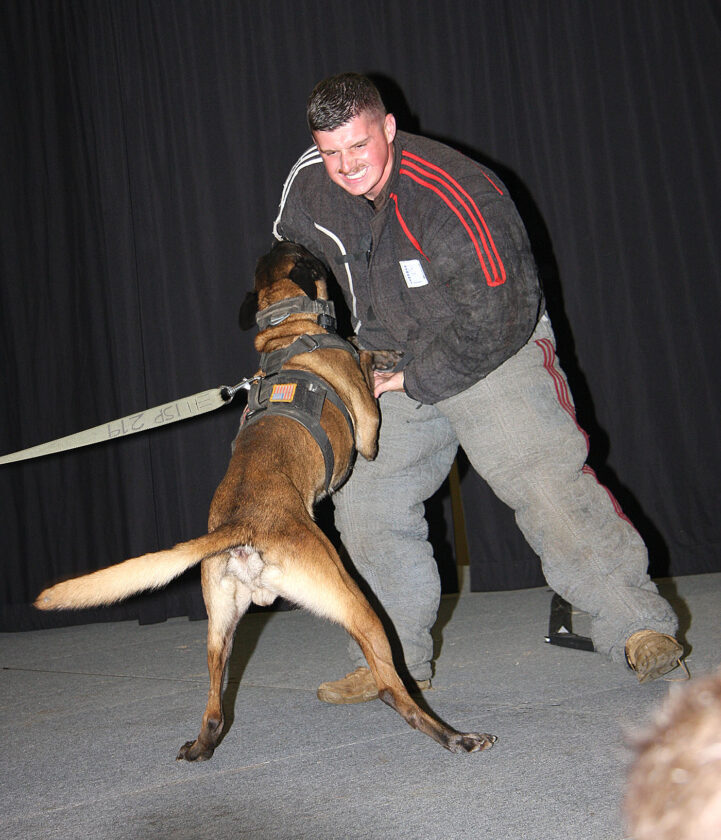
Iowa State Patrol Trooper Matthew Raes, of Council Bluffs, acted as a decoy of sorts, as troopers exhibited on a person exactly where they train dogs to bite criminals in order to get them to cooperate.
-
-Farm News photo by Karen Schwaller
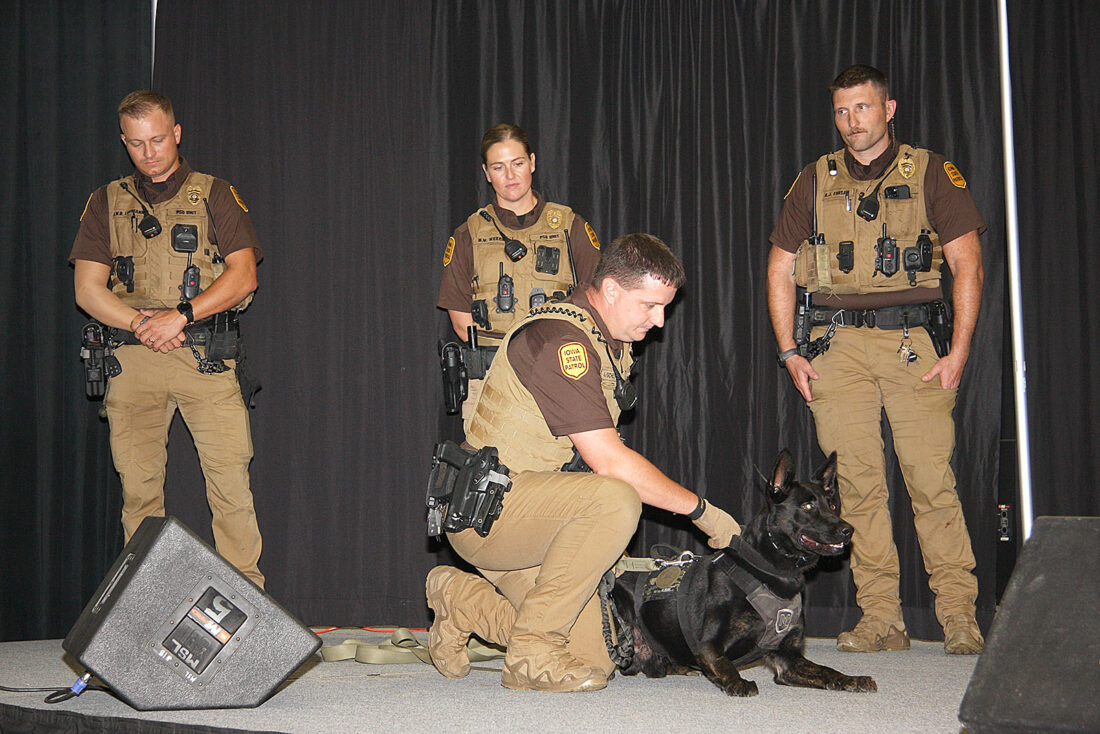
A K-9 dog awaits orders to attack; when given the order, no time was wasted for the dog to reach the intended (person) target and begin to bite/attack. Real bites and scratches often happen during training.
-Farm News photo by Karen Schwaller
Iowa State Patrol Trooper Matthew Raes, of Council Bluffs, acted as a decoy of sorts, as troopers exhibited on a person exactly where they train dogs to bite criminals in order to get them to cooperate.
SPENCER — A group of Iowa State Patrol officers demonstrated K-9 training during a special session in front of Clay County fairgoers in September.
Six dogs participated in the demonstration about the way police officers use the dogs, which are primarily for locating narcotics and patrol (keeping control of situations).
Sgt. Ryan Zenor with the state patrol’s Special Operations Unit headquartered in Des Moines explained that they call themselves the “PSD” (Police Service Dog) Unit. He said there are a lot of myths about the use of dogs in police work.
“If we have an animal that can do the work instead of one of us getting hurt, it works,” said Zenor, adding that many criminals don’t care if they see a group of officers standing before them in S.W.A.T. gear. “But if you throw a dog in front of them that’s barking, it’s over. A lot of what we use them for is deterrent.”
Zenor said they have eight police dogs around the state of Iowa, and that means there is a dog working in all four quadrants of the state on every shift.
-Farm News photo by Karen Schwaller
A K-9 dog awaits orders to attack; when given the order, no time was wasted for the dog to reach the intended (person) target and begin to bite/attack. Real bites and scratches often happen during training.
Their dog force consists of five Belgian malinois, two Dutch shepherds and one German shepherd. All dogs are males and are imported mostly from Europe. Zenor said female dogs are kept back in Europe to be bred.
“They breed dogs there the way we breed livestock here,” he said, adding that a champion stud dog is worth multi-millions there. “They use their female dogs for breeding stock.”
Zenor said when pups are six to eight months old and the state patrol would like to start looking for a dog, he watches dog videos in Europe for another six to eight months. The videos are sent to him by dog vendors there.
Once the dogs are 14 to 16 months old, they are sent to a handler in Arkansas, where local patrol officers will go to look them over and select which dogs they want. They look for drive, and “what they have in the tank.”
“We don’t look at dogs younger than 14 months,” said Zenor, saying they are too young to be a police dog at that age. “They need to be trainable.”
It takes about six months to train a dog to be certified.
He said a malinois dog’s mind goes a hundred miles an hour in a situation, and they don’t take time to analyze like a shepherd dog does. Zenor said that’s what makes them effective in police work — they just jump in and do what they’re told.
Training begins with a short period of denying them food if they don’t do what they are asked to do, such as sitting on command.
“I guarantee you that in 24 hours that dog will be sitting if you give it food only when he does what you ask,” said Zenor. “When that dog does sit (on command), you give him all the food for the last two days.”
Zenor said that for patrol work, they train the dogs to bite; and if they don’t do what they are asked to do, they are sent back to the squad car.
“To them that means they don’t get to play,” said Zenor. “And with narcotics work, if they don’t do what they’re told to do, they don’t get their toy. They quickly realize what they have to do to get rewarded.”
Police dogs do basic obedience training every day.
Zenor said when their dogs search for narcotics, they search for marijuana, cocaine and methamphetamine. To date, they can’t train dogs for locating fentanyl because even the smallest amount on a person can kill them.
Zenor said they are working with a lab in Oklahoma on creating a pseudo-form of fentanyl that will be safe for both officers and police dogs to handle.
Zenor had various handlers tell their dogs to find narcotics that were hidden on the stage. All narcotics were located by the dogs.
The dogs typically search in areas such as schools, by road sides and in cars parked on the side of the road. He said officers do not need a search warrant to search a car on the side of the road if there is probable cause that it needs to be searched.
“There is a lot of case law to follow, and we follow it very closely,” said Zenor. “If there is probable cause to search a car on the side of the road, we don’t need a warrant — that car is ours to search.”
Zenor said dogs don’t have depth perception, so if they approach steps (etc.), they only see a dark, bottomless hole, and hesitate to proceed. That’s why he said they train with slick floors, in the dark, etc., to get them used to being in those situations.
Zenor said all of the trainers have been bitten by their dogs during training, but not maliciously.
He said their dogs, when not working, are kept in kennels outside, with the exception of extreme heat or cold conditions. He said the dogs need to be ready to work no matter what the weather conditions are, and if they get used to comfortable heating and air conditioning, they may not feel like going to work if the weather is very hot or cold.
Conditions might include finding a suspect, or even a lost person, in a corn field when it’s 120 degrees in the rows. When searching for a lost child, a muzzle will be put on the dog as a preventative.
He said the dogs live each day to “go to work.”
When they train to attack, Zenor said officers don’t wear a lot of protective gear because they want the dogs to be able to feel bones when they bite. Their protective gear is no thicker than a duck winter jacket, but it doesn’t always protect them from some bites and scratches they may receive during dog training.
“We want bite pressure to where (the criminal) can’t take it anymore and they give up,” said Zenor, adding that the aim for their dogs is not to put someone in the hospital or create the need for stitches or large medical bills for law enforcement agencies.
“It hurts a lot (to train dogs to bite). We all have scars and bruises, but we take it as handlers for each other so our dogs fight the right way,” said Zenor.
Dogs are trained to go in deep for the bicep or tricep or the thigh.
“These dogs know where it hurts,” said Zenor.
Situations were role-played where a suspect resisted compliance with an officer, and the dog was sent in to take care of the situation. They demonstrated officer protection, as well as narcotics location.
Trooper Matthew Raes from Council Bluffs was in the training suit at the fair’s demonstration. He had an obvious long scratch on his upper arm after he took off the protective gear. But he said he’s willing to “take one for the team.”
“I like (doing this training) because it makes the dogs better every day,” he said. “We want the dogs to be the best in the unit and in the state, so we strive to train them the best.”
He said the group that was in Spencer travels the state weekly to help train PSD dogs, training in abandoned or vacant schools and houses.
“Schools are important to train in because they have a lot of rooms for dogs to search,” said Raes.
Zenor said dog commands are given in English, because that’s the language they hear and the language in which they are trained.
He said single-purpose police dogs (narcotics only) retire after nine or 10 years of service, and dual purpose dogs (narcotics and patrol) after eight or nine years. Patrol officers keep the dogs after they retire because they know them, having spent more time with them than their own families during their working years.
If they can’t be adopted by officers who know them after they retire, they have to be put down because of the threat to other people for what they are trained to do.
He said before July 1 of this year, PSD dogs were not considered as “peace officers.” But now they are, and if they are hurt, poisoned or intentionally injured (choked, bitten, etc.) by someone, it’s now considered a Class C felony.
Zenor said dogs do not always wear bullistic/stab-proof vests because they sometimes get too hot for them; but certain situations warrant it. Those vests cost just under $3,000 each. To date, most of the vests those dogs wear have been donated.
Zenor said they do all they can to train the dogs to protect the public and themselves, but it takes a lot of time and continuous training.
“These dogs are going to be as good as we make them,” he said.
Local News
Van Dyke: Cover crops not a fad
Extension to offer Local Food Leader 101 Workshop on Dec. 10–11 in Ames
AMES — Iowa State University Extension and Outreach’s Food Systems Team will offer Local Food Leader 101, an ...