
Out of options?
Consider these strategies to combat herbicide resistance
-
-Farm News photo by Darcy Dougherty Maulsby
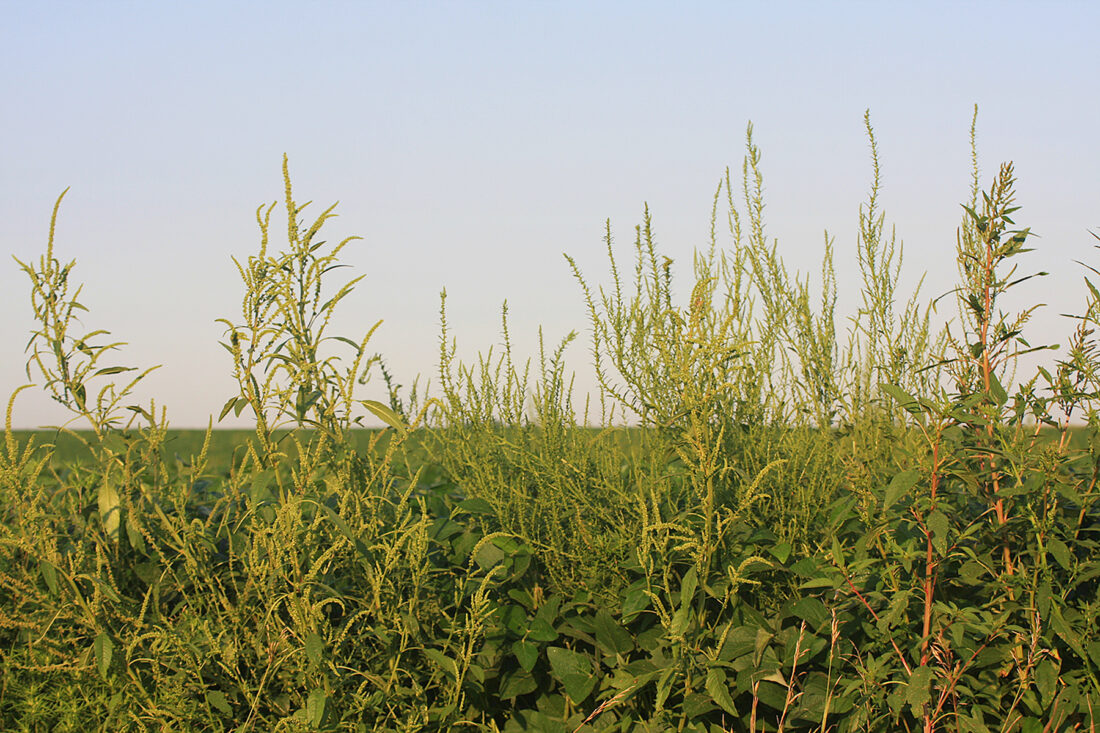
Due to metabolic resistance, weed populations could show resistance to yet-to-be-discovered herbicides, scientists report.
-
-Farm News photo by
Darcy Dougherty Maulsby
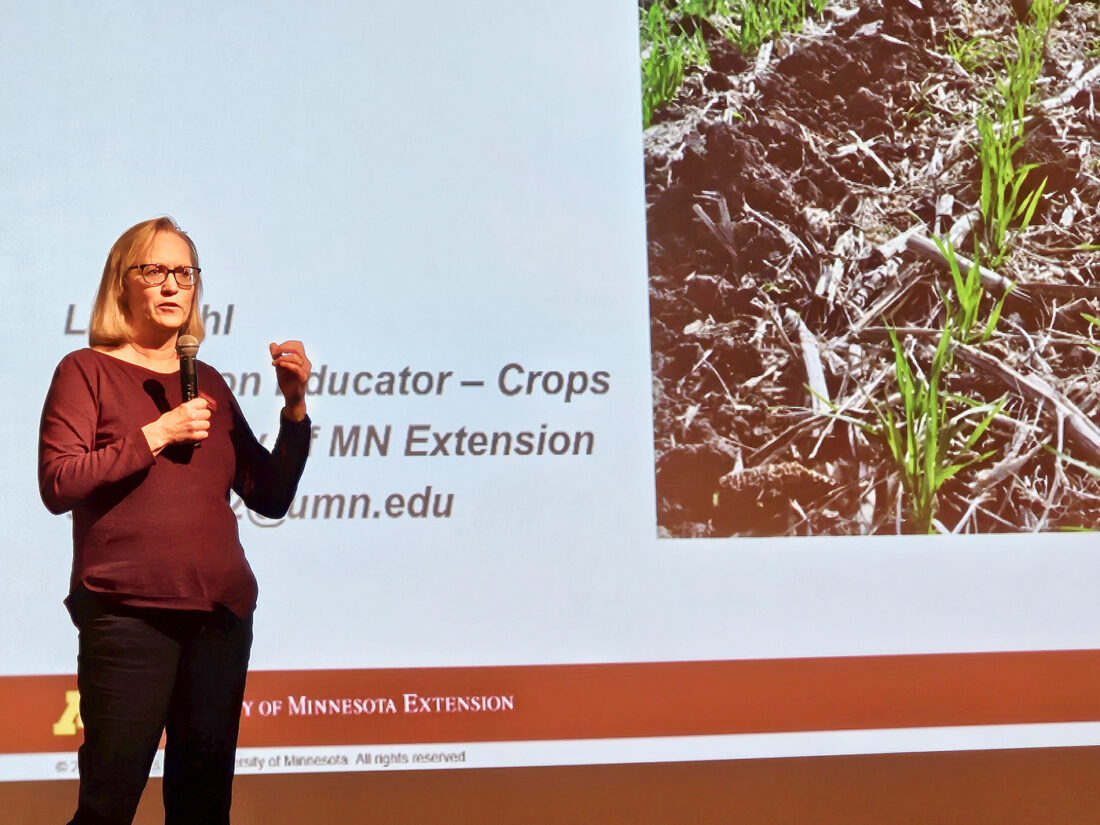
Liz Stahl, a University of Minnesota Extension educator who specializes in crops, notes that herbicide resistance continues to get worse. She offered tips to help farmers meet this challenge when she spoke at Iowa State University Extension’s Crop Advantage meeting in Storm Lake on Jan. 4.
-Farm News photo by Darcy Dougherty Maulsby
Due to metabolic resistance, weed populations could show resistance to yet-to-be-discovered herbicides, scientists report.
STORM LAKE — Think herbicide resistance just involves glyphosate or a few other modes of action? Think again.
“We’ve found six-way resistant waterhemp in Minnesota, and Illinois has documented seven-way resistant waterhemp,” said Liz Stahl, a University of Minnesota Extension educator who specializes in crops. “With this kind of resistance, you are really running out of options.”
While herbicide resistance isn’t new (resistant weed cases have climbed steadily in the
United States since the 1990s), the risk continues to grow, not only in Minnesota and Illinois, but Iowa.
“The situation with herbicide resistance just keeps getting worse, unfortunately,” said Stahl, who spoke at Iowa State University Extension’s Crop Advantage meeting in Storm Lake on Jan. 4.
-Farm News photo by
Darcy Dougherty Maulsby
Liz Stahl, a University of Minnesota Extension educator who specializes in crops, notes that herbicide resistance continues to get worse. She offered tips to help farmers meet this challenge when she spoke at Iowa State University Extension’s Crop Advantage meeting in Storm Lake on Jan. 4.
To get a clearer perspective on what farmers think about herbicide resistance, the University of Minnesota surveyed 675 respondents in 2023. Researchers asked, “Do you think you have weed resistance to any of the following on your farm?” A majority (83%) of respondents reported weed resistance issues with glyphosate (e.g. Roundup). One fifth of the farmers (20%) thought they had weed resistance to PPO inhibitors like Flexstar or Cobra. About 17% thought they had weed resistance to ALS inhibitors like Pursuit or FirstRate.
“The survey also showed that 12% of farmers said, ‘No, I don’t think so,’ when asked if they thought they had weed resistance on their farm,” Stahl said. “That view is probably not realistic.”
Consider the fact that there have been no new modes of action in more than 30 years, Stahl said. “We’re still working with herbicide technologies we’ve had for more than three decades.”
Research is also showing that more weeds are becoming resistant to herbicides they’ve never been sprayed with. While that might sound like science fiction, it occurs due to metabolic resistance.
Metabolic resistance is sometimes called “creeping resistance,” because of the way it evolves in populations, according to the University of Wisconsin-Madison (UWM). It occurs when plants survive low herbicide doses and metabolize some of the active ingredient. When these plants produce seed, subsequent generations are selected that can metabolize more and more herbicide, until the herbicide is no longer useful for weed control.
Consider a study from Illinois, which showed that waterhemp control with dicamba in two waterhemp populations with metabolic resistance to S-metolachlor (an active ingredient in Dual Magnum and other herbicides) decreased from 80% to 65% over just a few years.
Dicamba wasn’t even sprayed during that time, according to the UWM.
“Due to metabolic resistance, weed populations could show resistance to yet-to-be-discovered herbicides,” Stahl said.
Stop putting waterhemp seeds in the seed bank
Waterhemp remains one of the most challenging weeds to control. One waterhemp plant can produce 200,000 to 250,000 seeds or more a year.
In recent years, scientists at the University of Minnesota conducted the Herbicide Resistant Waterhemp Screening Project. They collected 90 samples from fields in 47 counties in Minnesota that had waterhemp escapes in 2020 and 2021. The researchers planted the seeds, grew the weeds in a greenhouse and applied herbicide at one times the label rate and three times the label rate. The experiments also included non-treated controls.
The scientists measured the percent survival of the weeds at 28 days after a herbicide treatment. While 76% of the samples were highly resistant (meaning more than a 40% survival at three times the label rate) to glyphosate, scientists also found high levels of resistance in newer options like Enlist herbicide.
“Already we’re seeing that 6% of the weeds in this study were highly resistant, and another 4 percent were moderately resistant,” Stahl said. “Why? 2, 4-D is the active ingredient in the Enlist system, and it’s been around for years.”
The data showed that 91% of weeds in the study were susceptible to Liberty herbicide.
“That doesn’t mean you should go gung ho with Liberty, though,” Stahl cautioned. “If you do, you’ll burn out that product, too.”
This study reflects the waterhemp conundrum. How do you manage a weed population for which there might not be any viable post-emergence herbicide options for weed control, plus there’s reduced residual control from many soil-applied herbicides?
“There is hope,” Stahl stressed.
Growers may need to implement earlier post-emergence applications; overlap residual herbicide applications; apply multiple, effective site-of-action each season; and/or utilize non-chemical control methods like mechanical weed control, cover crops and pulling weeds by hand.
“Who would have thought we’d be back to pulling weeds after all these years, but it is effective,” Stahl said.
The goal is to stop depositing waterhemp seeds in the seed bank. “As tough as waterhemp can be, it does have an Achilles’ heel,” she noted. “Waterhemp doesn’t last too long in the seed bank.”
She cited the 2007 research paper “Tillage, Cropping System, and Soil Depth Effects on Common Waterhemp Seed-Bank Persistence.” After four years of no additions to the seed bank, only 0.004% of the remaining waterhemp seed bank was viable, according to the report.
Take a diversified approach to weed management
It’s also important to keep giant ragweed under control. “On a scale of 1 to 10, with 10 being the most competitive, giant ragweed is a 10,” Stahl said. “It’s an early-emerging summer annual with a rapid growth rate and large leaf area that helps it outcompete and overshadow nearby plants.”
Giant ragweed has shown resistance to glyphosate and ALS-inhibiting herbicides, Stahl added. The University of Minnesota has conducted extensive research into giant ragweed control. The experiments have studied cover crops (specifically cereal rye), a variety of tillage practices (including conventional tillage, reduced tillage and no-till), pre-emerge herbicide applications and post-emerge herbicide applications.
For soybeans, using a cover crop and no-till, plus a burndown with a pre-emerge followed by a post-emerge, were more effective than conventional tillage. In corn, conventional tillage and no-till, plus a burndown with a pre-emerge followed by a post-emerge, provided better control of giant ragweed, as well as better yield.
The bottom line? A systems approach is needed, especially for weeds like giant ragweed and waterhemp.
“Herbicide resistance isn’t going away,” Stahl said. “A diversified approach is a necessity for long-term, effective weed management.”
Metabolic resistance in weeds makes this even more critical, she added. “Solutions to help manage tough weed control problems may not be the easiest, but the goal is to have these solutions pay off at harvest and in the long run.”
Stahl also encourages farmers to visit the Take Action website, which includes an array of resources to help manage herbicide, fungicide and insect resistance and preserve the usefulness of crop protection technology. Visit https://iwilltakeaction.com/about-take-action/.
Local News

Farmers plant while facing a harvest of worries
Profit margin slim, but feedlot owners carry on
Feenstra salutes House passage of Farm Bill
U.S. Rep. Randy Feenstra saluted the passage of a new Farm Bill by the full House of Representatives on ...