
Profit margin slim, but feedlot owners carry on
Blair Family Farm builds on the cattle industry
-
-Farm News photo by Lori Berglund
AJ and Kellie Blair each have their own focus and responsibilities within the family beef operation, but enjoy working together.
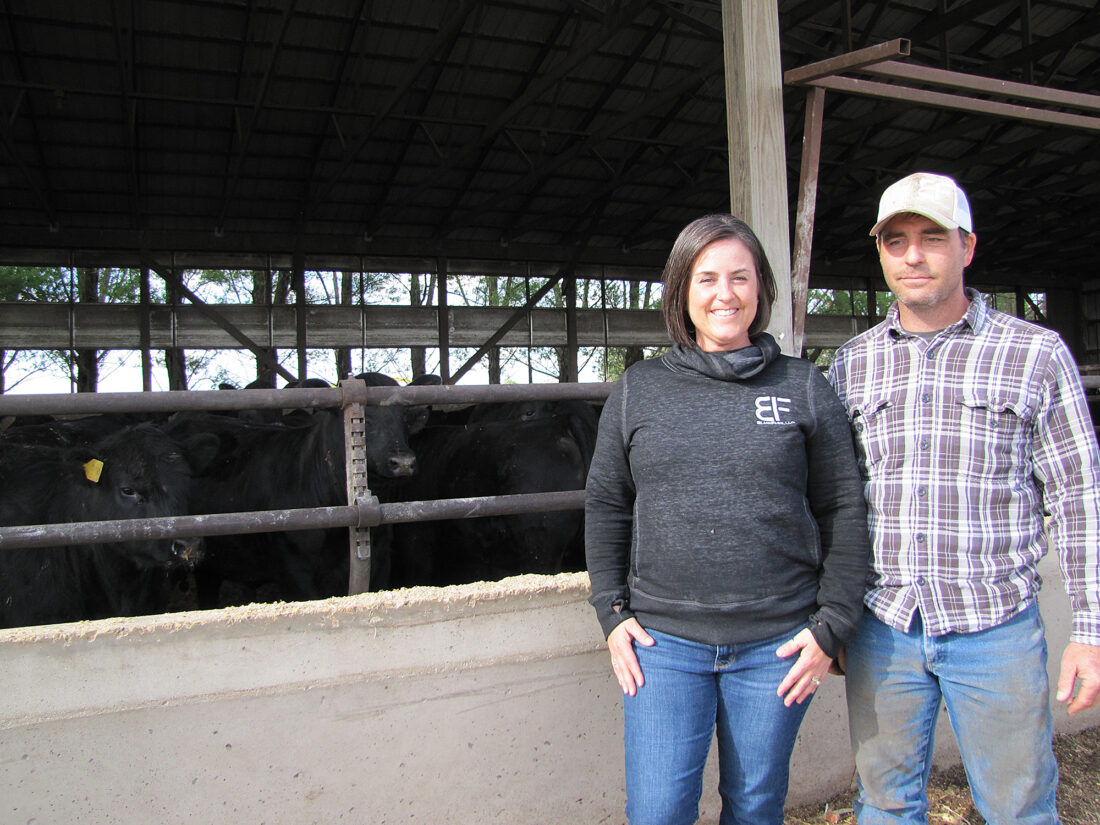
-Farm News photo by Lori Berglund
AJ and Kellie Blair each have their own focus and responsibilities within the family beef operation, but enjoy working together.
DAYTON — They are among the beef producers caught in the squeeze between the end consumers and initial producers.
A.J. and Kellie Blair don’t keep up on the price of hamburger at local grocery stores, but they do know the price of calves ready to feed out — and somewhere in the middle they are looking for a profit margin that will support their young family of four north of Dayton.
“On every group of cattle we buy, we look at how much we have to pay for them, how much is the feed going to cost, and what, if any, profit there is,” said Kellie Blair. “We look at that even before we buy.”
While the price of beef in grocery stores steadily climbs, the profit margin for those who feed calves out to market weight, is growing slimmer by the day. But all consumers know is that a pound of hamburger now costs them more than a gallon of gas — and they are both way more than they used to be.
A declining cow/calf herd in the United States is often cited as the cause of rising beef prices in stores. Some blame climate change for drought in Western states that produce a large share of calves. Here in Iowa, it’s competition for acres, as much of this prairie state is better suited to row crops than pleasant pasture for a mama cow and her calf. And, let’s face it, a cow/calf herd is a year-round, labor intensive operation.
“It used to be pretty common in Iowa to do a cow/calf operation and feed them out yourself, but not so much anymore,” explained A.J. Blair. “Nobody has the cows anymore. With all the row crop ground, there’s not so much pasture anymore.”
The couple returned to the farm where A.J. Blair grew up after graduating from Iowa State University and getting married in 2007. They each came from similar backgrounds, growing up on crop and livestock farms — Kellie at Pisgah in western Iowa, and A.J. on the home farm at Dayton. Both of their mothers worked in education.
A.J. Blair graduated with a degree in ag business from Iowa State in 2003, while Kellie Blair completed a double major in forestry and agronomy, also from Iowa State, in 2006. She worked off-farm for a few years doing nutrient management for a hog company before joining her husband to work full-time on the farm.
In addition to feeding out an average of 450 to 500 head, the couple custom feeds about 2,400 hogs annually. But there’s something about working with a beef animal that gives each of them the most pleasure.
“I would say we both prefer working with the cattle,” Kellie Blair said.
They chose cattle several years ago as a way to expand the farming operation to better support a growing family.
“We were looking for a growth area and decided to try beef,” A.J. Blair recalled.
“For young people coming back to a farm, livestock can be a way to do it, and so we decided to try,” Kellie Blair said. “We built the first monoslope barn in 2010 and then we added on in 2019.”
At one time, they also had a cow/calf operation, but have changed focus to the custom pigs and cattle feedlot currently.
“It’s kind of nice not to worry about calving, but I think eventually we’ll get back into it,” she said.
The couple works with a few regular buyers to purchase calves.
“We just kind of buy what works,” A.J. Blair said. “Sometimes smaller calves work, and it takes longer to feed them out. Sometimes you get bigger ones and you have them for seven or eight months. It kind of depends on what you can find and what you can pencil some profit into.”
Finding the profit has become harder and harder for this middle segment of the beef food chain. With the nationwide shortage of calves, it’s producers at the beginning of the life cycle who may be faring better, and the Blairs hold nothing against that.
“The cow/calf is where the extra money is, because there’s competition for them,” A.J. Blair said. “That’s why prices are high. There’s a lot of competition, so the cow/calf producers are getting a pretty good return, where historically they’ve probably gotten the least return. They’re finally getting a chance to buy new barbed wire, fix a tractor that’s been needing it for awhile.”
Like any farm operation, it’s a risk, and the Blairs well understand that. While some small farm cattle feedlots are empty because of the high price of calves, the couple keeps working to build their operation.
“On a feedlot, there’s just a small margin,” A.J. Blair said. “Sometimes you make money, sometimes you lose money, and that’s where you have to decide when we purchase the cattle how much risk do we want to take. Is there a chance to make a profit?”
But they always know why they are working so hard building an operation in a struggling economy. The couple has two children, Wyatt, 16, and Charlotte, 15, who each help on the farm.
“Wyatt really likes driving the equipment,” his mom said. “And Charlotte likes the animals, feeding our pets and things like that.”
They enjoy the fact that working together on the farm helps build a strong foundation for the family.
“That’s the nice thing about being a family farm, it seems like we’re always together,” Kellie Blair said.
A professional home office in one of the outbuildings helps separate family time from work time. The comfortable space is set up with multiple computer monitors and a table for greeting guests and dealing with business representatives.
Separating the office space from the home — and the kitchen table, where many farm families conduct business — helps them shut off at night and get a needed break from attention to work, Kellie Blair explained.
In addition to conventional sales, the couple also does some direct marketing for consumers who want to buy their beef fresh from the farm. Many want to know where their food comes from and that it was humanely raised. The Blairs completed the Iowa Beef Producers Quality Assurance Program and are registered direct sellers, although that is not a big part of their operation.
For direct sales, it’s often a learning curve for consumers who may not be familiar with the process. It can be a large dollar amount upfront, as the consumer must pay for first the animal and then the processing from a locker separately.
For the Blairs, their freezers are always full with their own home-grown beef. But that doesn’t mean it’s cheap, either.
“If we take one to the locker instead of selling a $3,000 to $4,000 animal, we’re just keeping it,” A.J. Blair said. “We’re keeping more dollars in the freezer.”
That just adds to the pride when they pull a roast out of the oven or slap a steak on the grill. And, while they may not keep up to date on store prices, they know exactly how many dollars and how much sweat it took to put that tasty beef on the table.
Local News
Farmers plant while facing a harvest of worries
Profit margin slim, but feedlot owners carry on
Feenstra salutes House passage of Farm Bill
U.S. Rep. Randy Feenstra saluted the passage of a new Farm Bill by the full House of Representatives on ...